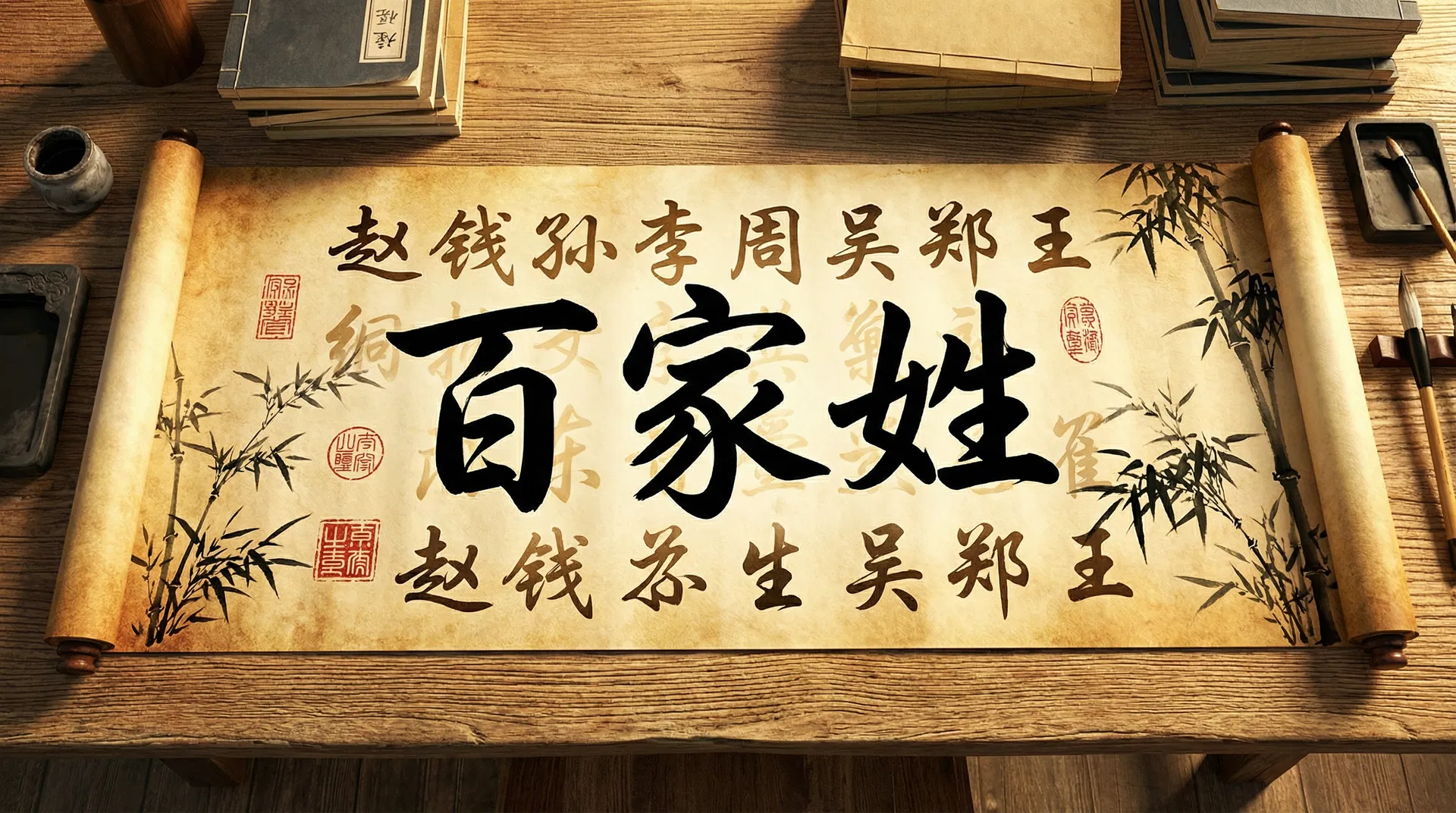
What is 百家姓?
The Bǎijiāxìng (百家姓) is a classic Chinese text composed during the early Song Dynasty (around 960 AD). It lists Chinese surnames in a rhythmic, four-character-per-line format that was traditionally used as a literacy primer for children. Despite its name meaning "Hundred Family Surnames", it actually contains 504 surnames — 444 single-character and 60 compound surnames. The order was not based on population but on political importance at the time:赵 (Zhào) came first because it was the emperor's surname.
Original Text (Excerpt)
赵钱孙李 周吴郑王 冯陈褚卫 蒋沈韩杨
朱秦尤许 何吕施张 孔曹严华 金魏陶姜
戚谢邹喻 柏水窦章 云苏潘葛 奚范彭郎
鲁韦昌马 苗凤花方 俞任袁柳 酆鲍史唐
费廉岑薛 雷贺倪汤 滕殷罗毕 郝邬安常
乐于时傅 皮卞齐康 伍余元卜 顾孟平黄
和穆萧尹 姚邵湛汪 祁毛禹狄 米贝明臧
计伏成戴 谈宋茅庞 熊纪舒屈 项祝董梁
Click any surname below to hear its pronunciation and learn its history
Top 20 Surnames in China
These 20 surnames account for over 70% of China's population. Click any card to learn more about its origin and famous bearers.
Famous Compound Surnames (复姓)
Compound surnames (复姓, fùxìng) consist of two characters. They are much rarer than single-character surnames, accounting for less than 1% of the population. Many originated from official titles, place names, or ethnic group names. Despite their rarity, compound surnames carry rich historical significance and are often associated with legendary figures.
Fun Facts About Chinese Surnames
王 (Wáng) and 李 (Lǐ) each have over 100 million bearers, making them the most common surnames in the world.
陈 (Chén) dominates in Fujian and Guangdong, while 张 (Zhāng) is most common in northern China. Surnames often reveal ancestral migration patterns.
Major dynasties spread their imperial surnames: 刘 (Liú) from Han,李 (Lǐ) from Tang, 赵 (Zhào) from Song, and 朱 (Zhū) from Ming.
Chinese surnames are romanized differently across regions:陈 becomes Chen (Mandarin), Chan (Cantonese), Tan (Hokkien), or Chin (Korean-Chinese).